The Esade Alumni Inner Life and Leadership Club brought together two of the voices with the strongest commitment to humanitarian action on the borders, Òscar Camps, founder of Open Arms, and the Jesuit Pau Vidal, SJ, the Jesuit delegate in Catalonia
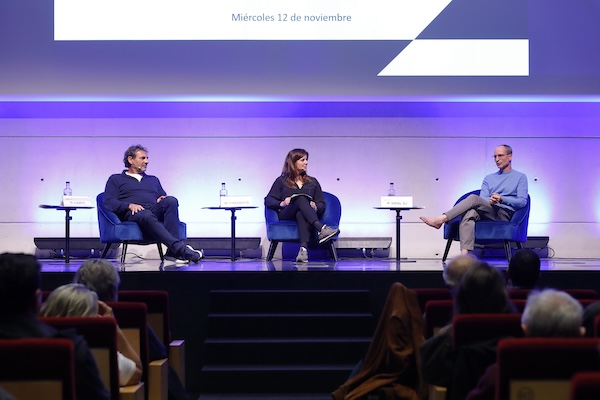
First, Òscar Camps shared his experience as a first responder, businessman, and founder of Open Arms, an organization that takes solidarity and the defense of life to an international level by both land and sea. Next, Pau Vidal, SJ, the Jesuit delegate in Catalonia, shared his experiences in refugee camps in Africa and the Americas, where he served as a leader inspired by the Christian faith and social justice. Mònica Casabayó (LIC&MBA 99), professor in Esade’s Marketing Department, led this encounter, which connected realities that are apparently different yet joined by the force of inner listening, commitment in action, and the capacity to inspire others.
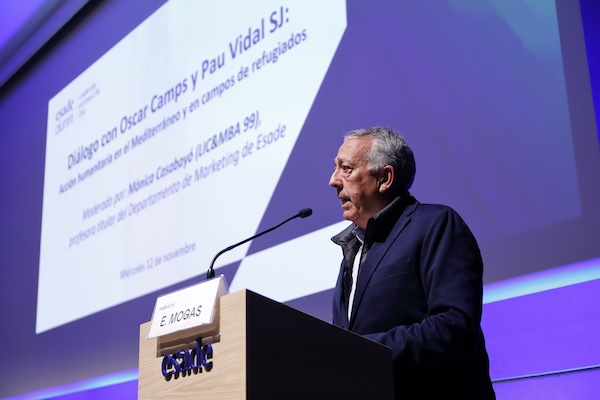
The encounter, which was introduced by Esteve Mogas (Lic&MBA 88), associate professor in Esade’s Department of Strategy and General Management, was a “qualitative leap to focus on action”: it compared the realities of direct action in the Mediterranean Sea and the work of providing support in refugee camps, showing that social justice requires a connection between activism and the institution. “Òscar and Pau are examples of leaders who are responsible with society and authentic with people,” he said.
Connection, training and conscience
From the start, Camps took an urgent tone regarding an unceasing crisis: “Unfortunately, for those of us working in cooperation, human rights, and the protection of the lives of the most vulnerable people at sea, the days are very similar and quite disheartening.”
Pau Vidal, SJ, in turn, contrasted his experience in camps like Kakuma (Kenya) – where his daily work involved “supporting the pains and hopes of my brother and sister refugees” – with his current institutional role. This Jesuit believes that both worlds should be “closely connected,” an idea that Camps turned into an ethical principle: “Training without conscience is worthless. It’s like a lighthouse without a light: you can see it, but it won’t guide you anywhere… The same engineer who can manufacture a drone to kill people can also manufacture a bridge to connect cultures.” At this point, Mònica Casabayó introduced the business school’s mission: “Esade faculty try to convey the values needed to transform the world, not only through knowledge and skills but also by developing a critical spirit and the human part of each student.”
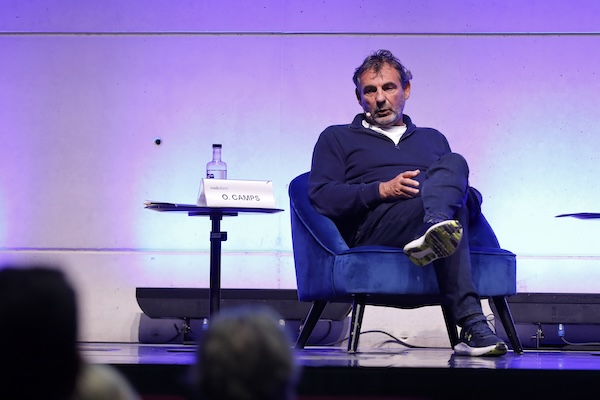
The highlight of the dialog was the reflection on the shift from inaction to action. Camps recounted his “awakening” at the age of 51 after seeing pictures of rafts full of people fleeing from the war in Syria. “Our sofa at home not only immobilizes us but also isolates us.” His decision to go to Lesbos and found Open Arms after encountering a “community” providing spontaneous assistance was his most powerful example: “You have to give it a try because you never know.” Ten years later, the NGO has rescued 73,000 people from the sea.
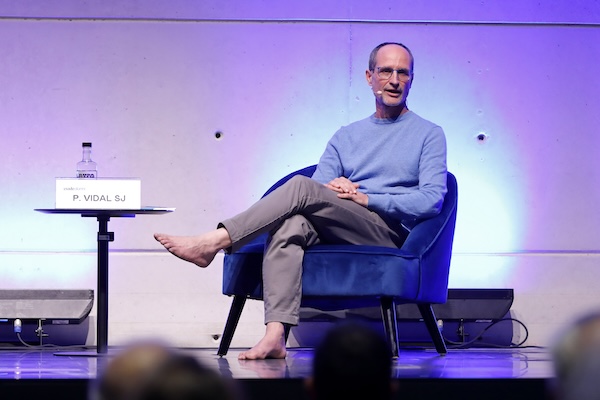
Pau Vidal, SJ, seconded this idea and identified the system as the obstacle: “The trap of the capitalistic system is that it leads us to believe that everything is very complex and you can’t do anything. But you can. Once you get started, you find community.”
Both concurred that frustration is handled through work and that motivation is buoyed by going back to humanistic roots. “We’re not talking about statistics; we’re talking about people. As soon as we dehumanize the other, we lose the motivation to help. We have to go back to stories, to humanistic accounts,” Pau stressed.
Responsibility for the present
The message to Esade’s new generations was direct and without concessions. Òscar Camps called them to immediate action: “I tell young people something they may not like: they are not the future, they’re the present. You don’t have to wait until you’re 51 to get off the sofa like I did…”
The Jesuit also warned about the danger of an individualistic spirituality, which has become part of the logic of consumption: “If wellbeing products don’t lead us to our brothers and sisters, our community, or even indignation, we should probably look at them with suspicion.”
The meeting concluded with Òscar Camps’s reflection that “people are always more than the acronyms that they represent” and with the closure by Ferran Macipe, a professor in the Department of Society, Politics, and Sustainability at Esade, who summarized the shift from inaction to action: “Thanks to Pau and Òscar’s testimonials, we have reflected on the sequence that goes from inner listening to the discovery of purpose and from there to action. It isn’t a science. There are many ways of travelling this path, different speeds, and many catalysts that can lead us to action, to get ourselves off the sofa and turn off the screen. It’s difficult to know when this will happen, but what is certain is that when it does we will not be alone. There will be people like us with whom we can build a community.” Macipe closed the event with a poetic reminder: “When we see the most vulnerable, when we stretch out our hands, the person we’re rescuing is often ourselves.”
Watch the complete video